The 1940s
New prototype
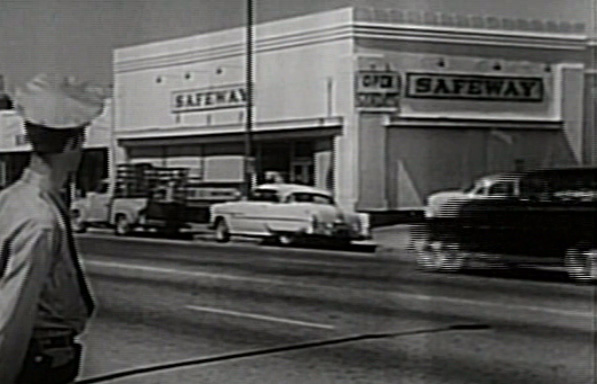
At the dawn of the 1940s, Safeway was operating hundreds of older units in taxpayer strips or on the first floors of apartment or commercial buildings, most of which were a fraction of the size of the new supermarkets that were opening around the country. Some of which dated from the 1920s self-service era and had originally operated under any number of other brands. While freestanding stores with parking lots had opened as early as the 1920s, this was not necessarily the norm, particularly in urban areas.
The 14 August 1941 Spokane Chronicle included an advertisement for Safeway’s new stores in the area. The average size had swelled to six thousand square feet for a new prototype that was beginning to be used nationwide. While the design was still rather urban and pedestrian-focused, with entrances directly from the sidewalk, many of these new stores also featured side parking lots. There were some regional variations, with a brick facade used more often on the East Coast. Most also featured Safeway’s red-on-yellow signage. Some also contained showers for employees. Considered “supermarkets” even though they were relatively small by the standards of some other chains and independents, the stores featured a full line of meats and produce.
Eastern expansion
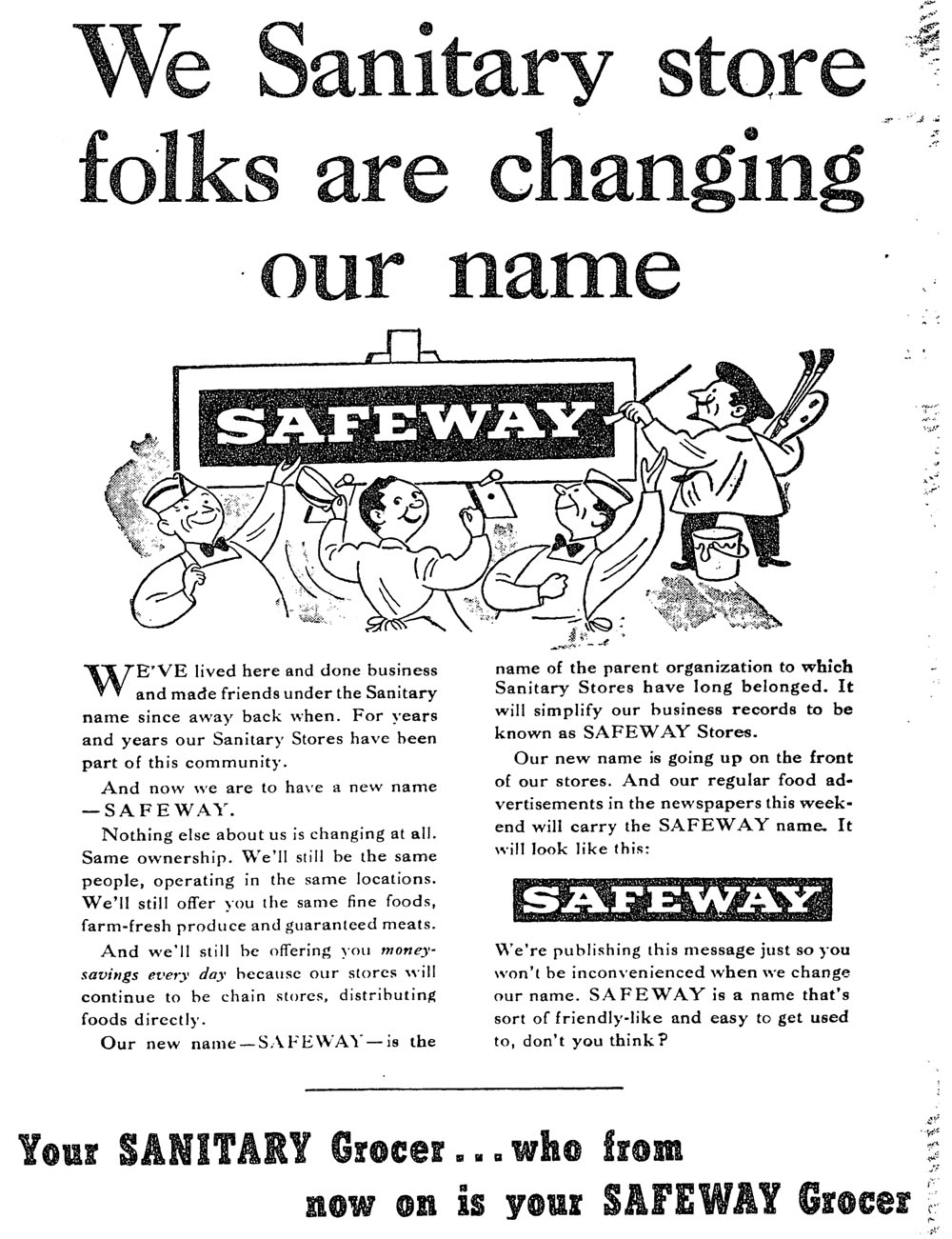
In 1940, Safeway’s 2671 stores were still primarily located west of the Mississippi River, with only one major Eastern outpost in the Washington DC/Northern Virginia area. In January, 1941, the DC stores, most of which had operated under the Sanitary and Piggly Wiggly banners, adopted the Safeway nameplate, ending the last of Safeway’s multiple brands following the mergers of the 1930s. Later that year, newspaper ads carried the tagline “Safeway: Your neighborhood sanitary store.”
The DC expansion was not to be the extent of Safeway’s Eastern strategy, however. In June, 1941, Safeway purchased 498 Daniel Reeves stores, 215 of which were in New York City. This was followed four months later by the acquisition of the National Grocery Co. of New Jersey, which added eighty-four self-service stores to the growing Safeway chain and resulted in the closing of “between 325 and 350 one-man stores” belonging to National. Almost overnight Safeway was a major presence in the nation’s largest metropolitan area.
Consolidation and growth
Wartime shortages and the consolidation of stores of different formats (and different lineage) combined to decrease Safeway’s store count to 2202 in 1949 despite the chain’s significantly larger geographic footprint—and its nearly threefold increase in sales during the period. The locational shift in Safeway’s home turf of San Francisco is illustrative: In 1940, following the mergers and acquisitions of the 1930s, there were 123 Safeway locations in San Francisco This total was reduced to 43 by the end of World War II and to 35 by the beginning of the 1950s. The casualties included many older Safeway locations as well as nearly all of the former Piggly Wiggly, Public, and Mutual/MacMarr stores. As the 1940s ended, none of the city’s original 1920s Skaggs or Safeway locations remained in operation, although one 1928 Piggly Wiggly on Castro Street still bore the Safeway name.
The Skaggs era ends
Safeway lost a tie with its origins in 1941 as Marion B. Skaggs, who had retired from active operations several years prior, also gave up his position as Chairman of the Board. Skaggs would live another thirty-five years, dying in 1976, and members of his family would be instrumental in the development of other food and drug chains around the country.

Jerry Kneifel
January 2, 2019 at 3:23pmI am with the Platte County Nebraska Historical Society and am trying to find the date when our Safeway store in Columbus Nebraska had a major fire in the 1940’s or early 1950’s. If you are able to find the date so that I could go through the old newspapers I would appreciate it. There was also a fire in the mid 1960’s of which is also of a secondary interest. Thank you for your assistance.
Bunola Hovey
February 8, 2019 at 1:41pmFound an old paper clipping about my Dad worked at Safeway store as a butcher. He became a manager before the store was closed at Marion, KS. Am trying to find out when was it closed (before or after I was born in 1940). Thanks!
Seth Miller
April 7, 2019 at 8:27amTrying to find out which stores sold the Snowy Peak brand of sodas. Thanks in advance.
Shirley
July 14, 2019 at 8:43pmCan anyone tell me when the Safeway in Fraser, CO was built?
Linda Blackford
May 27, 2020 at 10:06amI worked at the safeway store #0174, started when they had their grand opening. trying to find out if it was in 1963 or 1964.
Linda Blackford
Kevin McCabe
September 20, 2020 at 1:50pmWhat was the name Of the frozen poor boys that came two in a box , sold in the 70s. Thank You
Joe Garwood
January 31, 2021 at 1:49amMy grandfather was the manager when they built the first safeway in Julesburg Colorado. I have a picture of it taken in 1936 when it opened.
Christine Campbell
July 31, 2021 at 11:10amSuch cool history!!!
DONNA
August 29, 2021 at 3:37pmWas there a Continental Market in Fig Gargen Village Fresno Ca?
Jon Gianulias
December 31, 2021 at 12:32amHello, does anyone have photos of the former small Safeway across from Tower Theater in Sacramento, 16th & Broadway, we own that property and with redevelopment, looking to frame some history. Tower Records opened there in the 60s, so it was prior to that. Thank you. Jon Gianulias
Dave Holbrook
February 21, 2022 at 3:07pmI worked for San Mateo Co (CA) & have an photo from their archives of an old Safeway store (with a Sharkey’s Cab hut next to it) from the 1950s. But I NEED to find its location so I can include in a historical article I’m writing for the County’s history museum. But I can’t find anything on-line about location of original Safeway stores in SMCo. Happy to
Email a copy of the pic.
Groceteria
February 21, 2022 at 7:41pmUh, quite literally about 85% of this site consists of historical store location lists from around the country, including San Mateo County:
https://www.groceteria.com/place/california/san-mateo-county/
Sherry
August 21, 2022 at 7:12pmCan anyone tell me how to find out when the Washington, D.C. Safeway at 1747 Columbia Road NW became a Safeway store? In 1964, as a young bride whose husband was stationed in D.C., we lived in an old sandstone building a block over from Columbia Road, and I did my shopping at a grocery located in a string of small stores on Columbia. I don’t remember if it was Safeway at the time, but I’m trying to find the old building we lived in, a 4-story corner sandstone bldg with a broad set of concrete steps (lots, several dozen) up to the entrance. On Sundays, I know we rounded the corner onto Columbia and walked some distance straight down to National Baptist Memorial Church–passing what I believe was the current Safeway Store.
Grateful for any feedback,
Sherry
Groceteria
August 22, 2022 at 3:09pmI can narrow it down to sometime between 1948 and 1951.
DC stores list: https://www.groceteria.com/place/washington-dc/chain-supermarkets-in-washington-dc-1925-1975/
Sherry
September 2, 2022 at 1:18pmThanks so much. That would indicate it was the grocery store where we shopped, getting me closer to where that old apartment building must have been. It probably got demolished; yet there are still so many early 1900s buildings–I have to wonder.
RICHARD W PIERCE
January 1, 2023 at 11:00amRICHARD PIERCE navyus1940@gmail.com BORN IN SAN FRANCISCO 1940 CAME BACK FROM THE NAVY 1966 WORK FOR SAFWAY FROM 1963 TO 1971 meat cutter meat mgr. store mgr. MOVE TO NC JAMESTOWN WORK FOR BIG BEAR FOOD WORLD HATTIS TEETER. SEE YOU JAN 18
Ross Hollinger
May 12, 2023 at 8:37pmI was a Safeway employee in Kern County, CA from 1970 to 1979. I was at Niles St, Brundage Ln and Chester Ave in Bakersfield; and Central Valley Hwy and Shater Ave in Shafter. All three are still standing. My father was a store manager in various places in SoCal and my grandfather was retail operations manager for SoCal.